Two Introductions to Cybernetics
John F. Young's Cybernetics (1969) and F. H. George's Cybernetics (1971) — two short British primers on the young science of communication and control — read side by side and rebuilt as a navigable knowledge graph.
The two books agree on the foundations laid down by Norbert Wiener but pull in different directions: Young writes as an engineer who has read deeply in physiology, surveying real machines and the nervous systems they imitate; George writes as a theorist, climbing from logic and automata to applications in management and education. Twenty-eight shared concepts connect them. This site presents those concepts as an entailment mesh in the tradition of Gordon Pask — a network showing what depends on what — with a page behind every node describing how each book develops the idea.
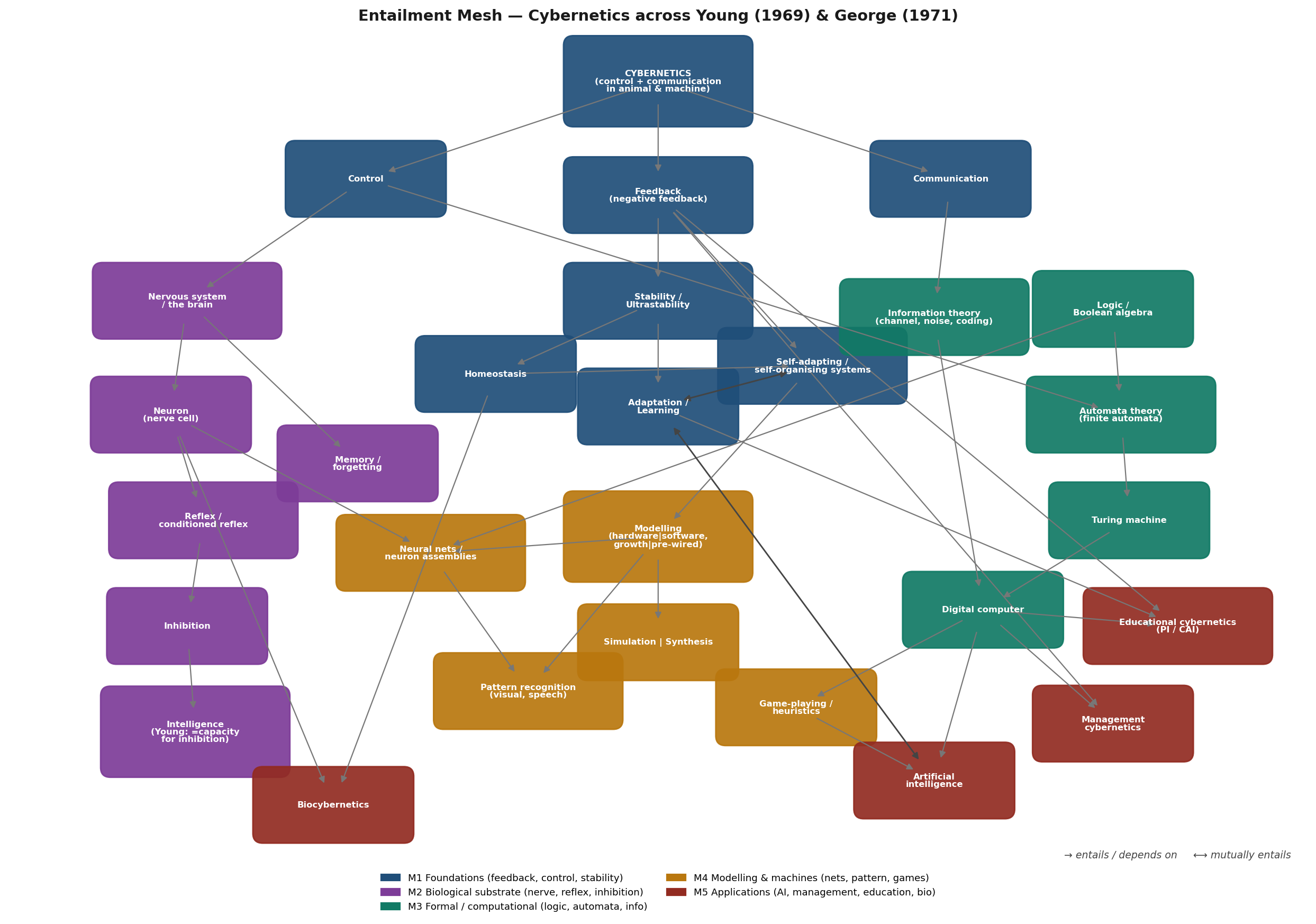
The entailment mesh at a glance — 28 concepts in five clusters. The interactive version below lets you click into any node.
Start here
The knowledge graph →
The 28 concepts as an interactive, zoomable network. Click any node to read its definition and how Young and George each treat it; toggle the recommended serialist order; filter by cluster.
Learning paths →
Two routes through the material: a serialist path that respects prerequisites one concept at a time, and a holist path that grasps each cluster as a whole before drilling in.
The five clusters
The concepts fall into five coherent groups — what Pask calls M-individuals, sub-networks that can be learned as a unit.
Foundations
Cybernetics · Control · Communication · Feedback · Stability / Ultra-stability · Homeostasis · Adaptation / Learning · Self-adapting systems
Biological substrate
Nervous system / brain · Neuron (nerve cell) · Reflex / conditioned reflex · Inhibition · Intelligence · Memory / forgetting
Formal / computational
Logic / Boolean algebra · Automata theory · Turing machine · Digital computer · Information theory
Modelling and machines
Neural nets / neuron assemblies · Modelling · Simulation | Synthesis · Pattern recognition · Game-playing / heuristics
Applications
Artificial intelligence · Management cybernetics · Educational cybernetics · Biocybernetics
The two books
An engineer's survey: the nervous system, then a tour of the machines built to imitate it, ending with two theses — that intelligence rests on the capacity for inhibition, and that forgetting is the neglected complement to memory.
A theorist's primer: foundations, then pure theory (logic, automata, computers, information), then applications (psychology, biology, management, education), built on the distinctions of simulation vs. synthesis and self-adapting systems.
A full comparative report (chapter-by-chapter summaries, key learning points and the entailment mesh) accompanies this site as Cybernetics_Comparative_Report.docx.